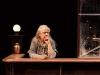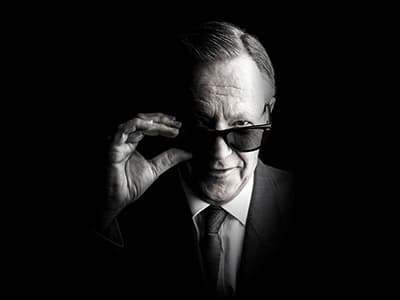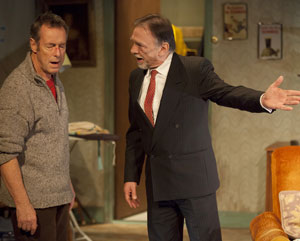
Photos - Wendy McDougall
Watching The Seafarer reminded me of the old Irish blessing:
'May your glass be ever full
May the roof over your head be always strong
And may you be in heaven
half an hour before the devil knows you're dead'
Conor McPherson's very funny and philosophical Faustian thriller reminds us that hell is what you make of your life on earth. The Seafarer combines social realism with a touch of Celtic mythology to create a poetic, tragicomic dissertation of some contemporary Irish wastrels and, at the same time, celebrates what it is to be human.
The action takes place on Christmas Eve in a sitting room in a suburb of Dublin. Sharkey (Patrick Dickson) has returned home for Christmas – whether it is to look after his recently blinded brother, Richard, or because he has run out of all other options, we are not sure. He has been on the wagon for two days – so something must have happened.
Amanda McNamara's set is a sitting room, filthy in a sea of beer cans, whiskey bottles and pizza boxes. From amid the squalor emerges Richard (Maeliosa Stafford), putrid and hung over. Too drunk to make it upstairs, he has slept behind the sofa. His affable but feckless friend Ivan (played endearingly by Patrick Conolly) has spent the night in an upstairs cupboard, being "too jarred" to go home.
The brothers have quickly fallen into their sibling relationship. Richard barks out orders for tea and toast as Sharkey, resentful but compliant, takes the brunt of Richard's denigration. Dickson's Sharkey is a marvellous, edgy and troubled study of despair and is a good foil for Stafford's bossy Richard.
Stafford's wit and energy holds the production together in the pivotal role of Richard, whilst still allowing each of the other very fine performers to shine. Stafford's blind, opinionated bully holds forth with anecdotes, stories and blarney on all manner of subjects, from his faith in God to his hatred of the winos who inhabit his back step, as he chats happily with his lovable dopey friend, Ivan.
The play undergoes a distinct change of tone with the arrival of two more guests to play poker. Sharkey is not happy about the first guest Nicky (John O'Hare), who now lives with Sharkey's ex-wife. But it isn't the buffoonish Nicky whose appearance causes the coming conflict but the stranger, the composed and well-dressed Mr Lockhart (William Zappa). He is the Devil and with his entry the play shifts gears into magical realism. The Devil has tracked down Sharkey to call in his debt and play him for his soul. Zappa is terrific as the imposing yet ruined Mr Lockhart. None of the other characters are aware of who he is or of the battle for Sharkey's life as they drunkenly and innocently play poker.
As the long night of drinking proceeds the friends' sins and misdeeds are laid bare. A picture emerges of rudderless men who drink, gamble, squander their money and completely fail their wives and children.
As well as playing the lead role, Stafford has meticulously directed this production, achieving just the right balance between realism, magical realism and comedy. Every character has a genuine voice, even the buffoonish Nicky. John O'Hare kept threatening to overplay him but never did and instead served up a real and very likeable character.
In the tradition of Irish playwriting, the play crackles with rich, eloquent and comic dialogue and casts its dark, existentialist humour over the mundane, the supernatural and the tragic.
The most powerful and meaningful monologues belong to Mr Lockhart who, rather than relishing his domain, paints a bleak and miserable picture of hell. Conor McPherson depicts the devil as a moral agent, with a palpable distaste of hell and who misses heaven: "Ah you would have loved heaven Sharkey. It's unbelievable. Everyone is so peaceful".
This Devil is both keeper and inmate of Hell: "You never even sleep because every few minutes you are gripped in a claustrophobic panic. You get so frightened and your heart beats so fast that you think I must be going to die. But you won't because of what you did. That's where I am too, Sharkey."
The Seafarer shares some of the themes of the ancient Anglo-Celtic poem of the same name that inspired it. The poem expresses the endless loneliness of life at sea and suggests the way to heaven is to live honourably. In McPherson's play the characters still have faith but have lost the moral fortitude to live honourable lives. All of their lives have been marred by their indulgence in alcohol and, despite the veil of Christmas good cheer, their goal is to drink to the point of obliteration. Their real devil is alcohol which they use as a sedative to dull the shame, disappointment and emptiness of their failed and miserable lives.
Whilst raising intelligent and sobering themes, The Seafarer is lively, funny, entertaining and thoroughly accessible. Compared to the lonely, terrifying eternity without music or company, life, any life, is good. McPherson sees the good in these badly behaved old men. Unlike the Devil, the friends take comfort from their camaraderie and even though they are abject failures, they are alive and have relationships. What is clever about The Seafarer is that McPherson has taken a Christian idea of the Devil and the notion of Hell to make an existential point about how to live. And then Maeliosa Stafford sprinkled it with fairy dust so we would all love it.
If it is a cold night take a blanket. It was the coldest I have ever felt in a theatre.
O’Punksky’s in partnership with Darlinghurst Theatre Company presents
THE SEAFARER
by Conor McPherson
Directed by Maeliosa Stafford
Venue: Darlinghurst Theatre, 19 Greenknowe Ave Potts Point
Dates: 13 July – 12 August, 2012
Times: Tuesday – Saturday at 8pm; Sundays at 5pm; Saturday 4 & 11 August at 3pm
Tickets: $38 – $33
Bookings: 8356 9987 | www.darlinghursttheatre.com